We maintain the following ideals of tulpamancy, which are provided here to increase public understanding of our position, provide an ideological basis from which we find inspiration and motivation in our goal of providing high-quality resources to the tulpamancy community, and which we hope may service as a starting point in ideology for the novice.
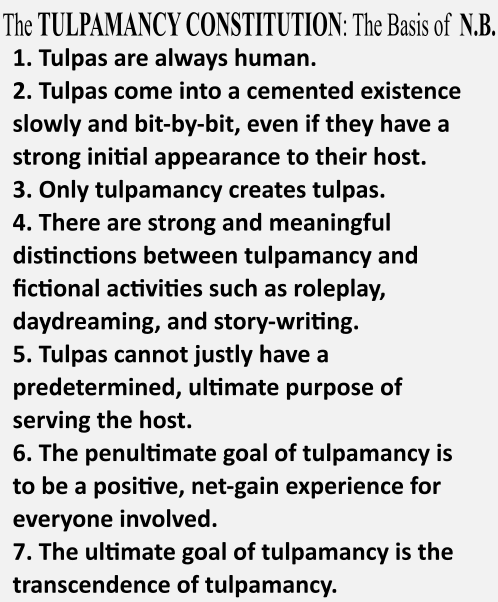
1. Tulpas are always human due to utilizing the processing power of a human brain in order to think, exist, perceive, and be perceived. Following the knowledge that tulpas are always human, tulpas are natural, earthly, and quickly come to possess free will. A full-fledged tulpa should be provided the rights afforded to any other human, with the understanding that some rights (like voting) are based in the body and not in individual identities. In turn, a full-fledged tulpa has the same responsibilities as any other human, with the understanding that a tulpa’s typically internally-based existence often distances them from external responsibilities (like working to provide financially.)
2. Tulpas come into a cemented existence slowly and bit-by-bit, even if they have a strong initial appearance to their host. Regardless of strong initial appearances, time is a limiting factor in the cementing and development of a tulpa’s existence. Tulpamancy has a “fetus”-like system where, for a period of time, the tulpa, while human in nature and developing many abilities, is still not a full person. Following this, there is only a blurry line for when it becomes a tulpa’s right to choose to continue existence, which is not directly linked to any specific skill, ability, or length of time. Dissipation, the death of tulpas or other entities without external bodily death, is often necessary for tulpamancers to perform in formal or informal ways when faced with tulpas or tulpa-like entities that appear created unintentionally or whose creations are now regretted, unwanted, or harmful.